
 By Sandeep Verma
New Delhi, May 12: A land deal that might have passed quietly through the columns of routine bureaucratic filings has now become one of the most uncomfortable controversies in Indian administrative circles. At the centre of it is a single registered transaction, dated April 4, 2022, in which nearly 50 serving IAS and IPS officers jointly purchased approximately five acres of agricultural land in Guradi Ghat village, Kolar area, Bhopal. What followed over the next two years, a major highway approval, a land-use conversion, and an eleven-fold surge in property prices, has triggered a nationwide debate on conflict of interest, insider knowledge, and the thin line between legal investment and institutional betrayal.
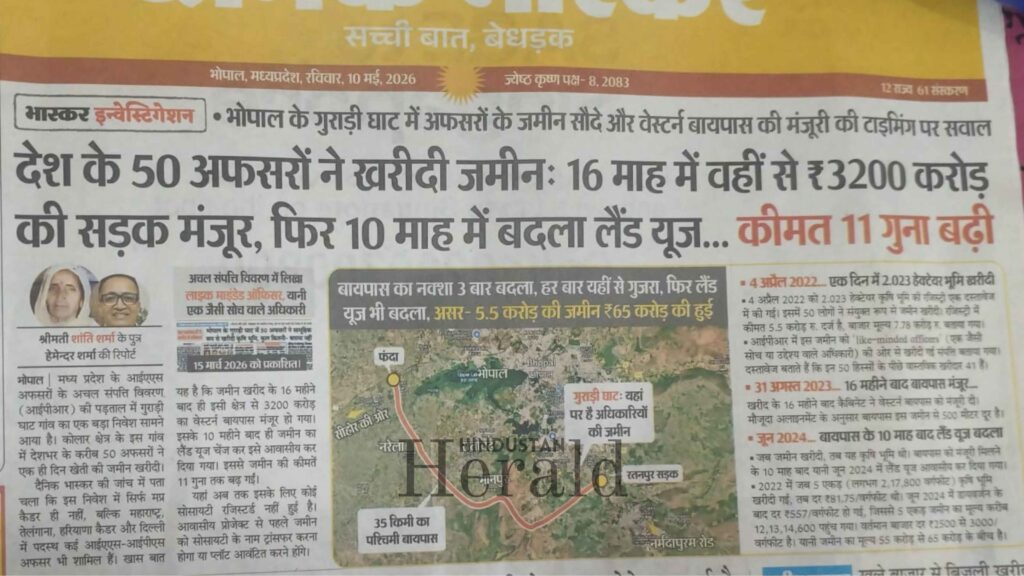
The story, first reported by Dainik Bhaskar through an investigation into Immovable Property Returns (IPRs), has since been picked up by national outlets and is generating sharp questions about how India regulates the financial behaviour of its top civil servants.
The Deal That Started It All
According to the Dainik Bhaskar investigation, the officers jointly purchased 2.023 hectares of agricultural land in Guradi Ghat village in Bhopal’s Kolar area on April 4, 2022. The transaction was registered in a single document for approximately Rs 5.5 crore, with the market value at the time listed at Rs 7.78 crore, or roughly Rs 82 per square foot.
Although the registry lists 50 shareholders, records indicate there were actually 41 principal buyers behind the investment.
The buyers included officers from the Madhya Pradesh cadre as well as officials associated with Maharashtra, Telangana, Haryana, and central postings in Delhi. In their Immovable Property Returns, the investment was reportedly described as a collective purchase by “like-minded officers.”
That phrase, “like-minded officers,” is now being scrutinised with considerable suspicion. Critics argue that it signals not a casual coincidence of investment interests, but a coordinated, possibly pre-planned acquisition of land that officers had reason to believe would become enormously valuable.
Sixteen Months Later: The Bypass Arrives
The Rs 3,200 crore Western Bypass project was approved 16 months after the land deal, by the Madhya Pradesh cabinet on August 31, 2023. As per the current route plan, the bypass is located just 500 metres from the land.
The timing alone would have raised eyebrows. But what followed made it impossible to ignore.

Ten months after the bypass approval, in June 2024, the land use was officially changed from agricultural to residential. In 2022, the rate of the approximately 2.17 lakh sq ft of land was Rs 82 per sq ft. After the diversion in June 2024, it rose to Rs 557 per sq ft, taking the estimated value to approximately Rs 12 crore. Currently, land prices in the area have reached Rs 2,500 to Rs 3,000 per sq ft, putting the total value of the same land at somewhere between Rs 55 crore and Rs 65 crore.
To put that plainly: a group of government officers collectively bought land worth Rs 5.5 crore. That land is now reportedly worth up to Rs 65 crore. That is not modest appreciation. That is a return that most private equity funds would struggle to match.
The Insider Trading Question
The controversy has quickly moved beyond the facts of one transaction. It has reopened a structural debate about how India’s governance architecture handles the intersection of public authority and private wealth.
The key issue, as analysts have pointed out, is not whether civil servants can legally buy land. They can. Indian bureaucrats are allowed to own property and must disclose it through annual Immovable Property Returns under service conduct rules. The concern is whether access to privileged planning information creates an uneven playing field when public officials invest in areas tied to future government infrastructure decisions.
In financial markets, this would be a clean case for the Securities and Exchange Board of India (SEBI). Trading on material non-public information, what regulators call insider trading, is a criminal offence under the SEBI Act. But India’s land market operates without any equivalent regulatory framework. There is no body that monitors whether a senior bureaucrat with advance knowledge of an infrastructure corridor quietly acquires property along that route before the announcement is made.
Infrastructure decisions create enormous wealth transfers. A new highway, airport, industrial corridor, or metro line can multiply land prices overnight. Those who know first often benefit first. In stock markets, regulators classify that informational advantage as potentially illegal. In land markets, India largely treats it as an ethical issue unless investigators can prove corruption, a quid pro quo arrangement, or misuse of office. That legal asymmetry remains striking.
Who Is Calling for Action?
The response from institutions has, so far, been notably quiet.
As of May 11, 2026, the Madhya Pradesh government had not issued any official statement or announced a formal probe into the matter. Officers involved have not publicly commented on the reports.

That silence, for many observers, is itself a problem. When allegations of this scale emerge, involving nearly 50 senior officers across multiple state cadres and central postings, the absence of even a preliminary inquiry sends a troubling signal about institutional accountability.
Entrepreneur Vikas Saraswat and former DGP Shesh Paul Vaid are among those who have publicly called for a thorough investigation, with many on social media comparing the sequence of events to “insider trading” in real estate.
Those defending the officers argue that the purchase was disclosed in official records, that infrastructure projects naturally raise land values across entire regions, and that proximity to a future bypass does not automatically constitute wrongdoing. That argument has merit as far as it goes. But it sidesteps the central question: did these officers have access, by virtue of their positions, to planning information that ordinary citizens did not?
A Pattern Bigger Than Bhopal
This is not the first time that questions of this nature have surfaced in India’s administrative landscape.
After the bifurcation of Andhra Pradesh in 2014, opposition parties alleged that politically connected individuals purchased land in villages later included in the proposed capital region before official announcements were made. Several cases and investigations followed, though the matter became heavily politicised and legally contested. Again, the debate revolved around advance knowledge.
What makes the Bhopal case distinct is that the buyers are not businessmen with political connections. They are serving officers of the Indian Administrative Service and Indian Police Service, people whose entire authority derives from the trust that the public places in their impartiality and integrity. The IAS is constitutionally designed to be a firewall between political power and administrative decision-making. The IPS is similarly expected to operate above suspicion.
When officers from these services invest collectively in land that sits 500 metres from a government project approved 16 months after their purchase, the reputational damage is not limited to those 50 individuals. It lands on the entire institutional architecture of India’s civil services.
What the Rules Say, and Where They Fall Short
Under the All India Services (Conduct) Rules, 1968, government servants are required to file annual property returns and must seek prior permission before making certain transactions beyond a defined threshold. The officers in this case did disclose the investment in their IPRs. By the letter of existing rules, that may be sufficient.
But conduct rules were written for a different era, one where infrastructure planning was less centralised, project routes were not digitally mapped years in advance, and information asymmetries between insiders and the public were less starkly consequential. The rules have not kept pace with the scale and financial significance of modern infrastructure decisions.
There is a reasonable case to be made that senior civil servants should be legally barred from purchasing land in any district or corridor that they have reason to know is under infrastructure planning consideration, whether or not they are directly involved in that project. Several democracies impose similar restrictions on legislators and senior executives in planning bodies. India does not.
What Happens Next?
While no wrongdoing has been officially established, the timing of these developments has prompted questions regarding transparency and conflict-of-interest safeguards.
The Madhya Pradesh government faces pressure, at minimum, to explain the sequence of events and clarify whether any of the 50 officers had access to planning documents related to the Western Bypass before the cabinet’s August 2023 approval. The Department of Personnel and Training (DoPT) at the Centre could also initiate a review under the conduct rules, though there is no public indication that it intends to do so.
In the absence of official action, this story will likely remain a matter of media scrutiny and public anger, which is, in itself, a damning statement about how India currently handles accountability in its highest administrative ranks.
For now, the land in Guradi Ghat village sits 500 metres from a bypass that did not exist when 50 officers decided to buy it together. Whether that proximity was coincidence, foresight, or something more troubling is the question that India’s institutions are yet to answer.
Stay ahead with Hindustan Herald — bringing you trusted news, sharp analysis, and stories that matter across Politics, Business, Technology, Sports, Entertainment, Lifestyle, and more.
Connect with us on Facebook, Instagram, X (Twitter), LinkedIn, YouTube, and join our Telegram community @hindustanherald for real-time updates.

Regional journalist bringing grassroots perspectives and stories from towns and cities across India.
- Sandeep Verma

- Sandeep Verma
- Sandeep Verma
- Sandeep Verma




 Ananya Sharma