
 By Shelesh Joshi and Rajiv Menon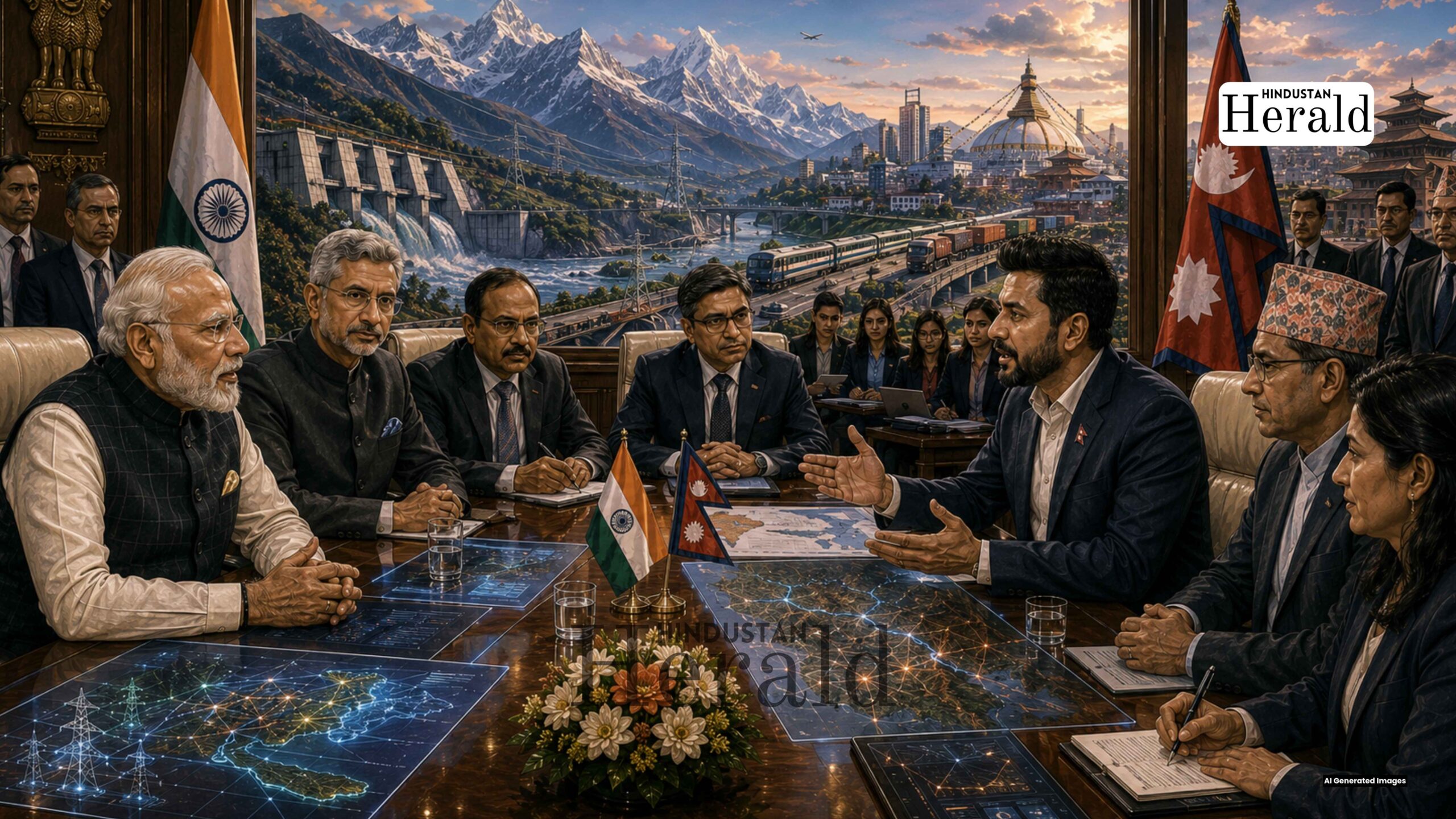
New Delhi, June 3: Something felt different about Wednesday’s meeting and anyone who follows India Nepal relations closely would have noticed it immediately. It was not the statements. The statements were fine, appropriately warm, full of the kind of language that gets written into diplomatic readouts and then read by almost nobody. “Special and multifaceted relationship.” “Priority partner.” “Greater heights.” You have seen these phrases before. You will see them again. What was different was the room.
Prime Minister Modi was there, obviously. But so was S. Jaishankar. And Ajit Doval. And Vikram Misri. All three of them, together, for a meeting with a man who is not Nepal’s Prime Minister, not its Foreign Minister, not even a member of its cabinet. Rabi Lamichhane is the chairman of the Rastriya Swatantra Party. He runs the party. Someone else runs the government. And yet India sent everyone.
You do not do that by accident. You do not accidentally put your National Security Advisor and your External Affairs Minister and your Foreign Secretary in the same room for a visit that protocol does not require it for. Someone decided this meeting needed that weight behind it. That decision is the actual news here, more than anything that was said inside the room.
This is what India Nepal relations look like when New Delhi is genuinely paying attention. Not a junior minister with a garland and a prepared statement. Not a routine bilateral that gets three paragraphs in the foreign desk and disappears. The full cabinet. The full signal. A meeting that was designed, from the attendance list up, to communicate something specific to Kathmandu about how seriously India is taking this particular political moment.
Prime Minister Modi, posting on X after the meeting, described Nepal as “a priority partner under our Neighbourhood First policy” and said India looks forward to elevating “the special and multifaceted relationship” between the two countries. Fine words. But the meeting’s real statement was not in the language. It was in the attendance list.
And for anyone watching India Nepal relations from Kathmandu, from Beijing, or from any foreign ministry that tracks South Asian diplomacy seriously, that attendance list said everything the official statement was too diplomatic to say directly.
Quick Summary
- PM Narendra Modi met RSP Chairman Rabi Lamichhane on June 3, 2026 in New Delhi, with EAM Jaishankar, NSA Doval, and Foreign Secretary Misri all seated in the same room, a level of attendance that goes far beyond standard diplomatic courtesy.
- The RSP won 182 of 275 seats in Nepal’s March 5, 2026 election, the strongest single party majority Nepal has produced since democracy was restored in 1990, and the party was founded only four years ago.
- Balendra Shah, who is 35 years old and was a rapper before he became a politician, was sworn in as Nepal’s youngest ever Prime Minister on March 27, 2026.
- Home Minister Amit Shah had already met the Nepali delegation the previous day on June 2, which means India gave this visit two consecutive days of senior level attention.
- Nepal’s economy is expected to grow at just 2.7% this fiscal year according to the Asian Development Bank, which gives the new government a fairly narrow window to show its voters that things are actually changing.
- The RSP went into the election promising “balanced and dynamic diplomacy” with both India and China, which is a polite way of saying they are not going to let either neighbour take them for granted anymore.
India Nepal Relations: Nobody Builds a Party Like This in Four Years
The Rastriya Swatantra Party did not just win an election. It ended something. The RSP, which did not exist four years ago, walked into a general election on March 5 and came out with 182 of 275 seats in Nepal’s lower house. The established parties, the Nepali Congress, the communist formations, the coalition veterans who have traded the prime ministership amongst themselves for thirty years, were left looking at results that barely seemed real.
The RSP was founded in 2022 by Lamichhane himself, a former television journalist who became famous for a kind of political interviewing Nepal had not really seen before. His show “Sidha Kura Janata Sanga,” which translates as Straight Talk with the People, was exactly what it sounds like. He asked uncomfortable questions. He did not let answers slide. People watched, and then eventually people voted.
His party tapped into something that had been building for years in Nepal. A deep, grinding exhaustion with the political class. Corruption cases that went nowhere. Infrastructure projects that stayed on paper. A government carousel that spun so fast nobody could keep track of who was prime minister at any given moment. The RSP said all of this out loud, without much diplomatic softening, and an entire country said yes.
The face they eventually put forward for Prime Minister was Balendra Shah, known to most Nepalis simply as Balen. He is 35 years old. He was a rapper. He became the mayor of Kathmandu and turned out to be genuinely good at it, fixing roads, cracking down on encroachments, doing unglamorous things well. He joined the RSP in December 2025, and whatever momentum the party already had, it doubled after that.
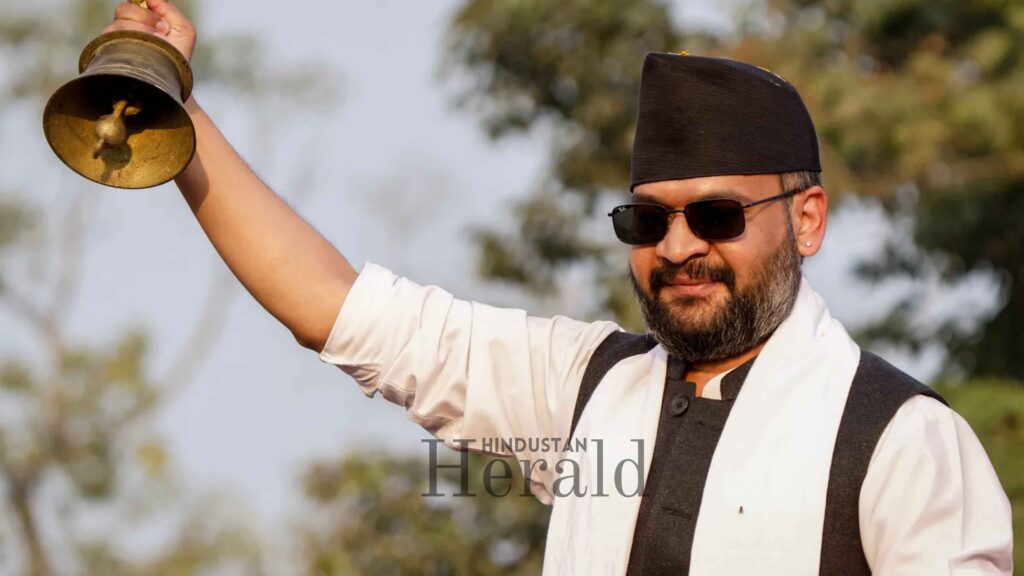
Shah was sworn in on March 27, the youngest person to ever hold that office in Nepal’s history. And in a country where political history is usually measured in weeks before the next collapse, the RSP now has a majority so large it does not need anyone’s permission to govern.
For India, watching all of this from across a very consequential border, the question was not whether to engage. The question was how quickly and how visibly.
South Block Does Not Do This Accidentally
India responded with a speed that diplomatic observers noted immediately. On the day Shah was sworn in, New Delhi extended a formal invitation for him to visit India. That same day. Not after a review period. Not after pleasantries were exchanged through back channels. The same day.
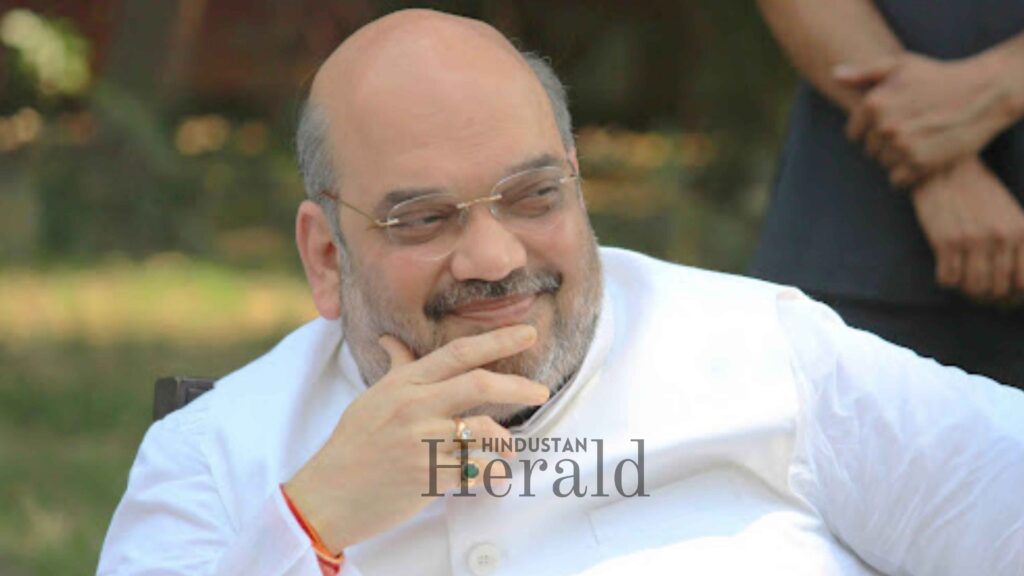
Home Minister Amit Shah received the Nepali delegation on June 2. The Prime Minister’s meeting followed on June 3. Two consecutive days. Every major figure in India’s foreign policy architecture, present and accounted for.
Part of what is driving this urgency is something India has been quietly desperate for in Nepal for a long time: a government that will actually last.
Nepal has had ten prime ministers in the last ten years. Coalitions have formed, collapsed, reformed with different partners, and collapsed again in cycles that made serious long term cooperation nearly impossible. India would negotiate agreements, projects would get announced, and then the government would change and the new coalition would have different priorities or different patrons in Beijing or Washington and the whole thing would start again.
The RSP has a near two thirds majority. Analysts across the board, including those not particularly sympathetic to the party, expect it to serve a full five year term. That is an extraordinary thing to say about a Nepali government, and in New Delhi, the implication was obvious. Here, finally, is a partner worth investing in seriously.
As reported by The Federal, India has also been trying to move past a diplomatic approach to Nepal that had grown stale. The traditional playbook, high level visits, project announcements, cultural exchanges, had started to feel routine in a way that produced diminishing returns. The RSP’s emergence is, if nothing else, a genuine opportunity for a reset, and South Block appears to know it.
There is one complication though, and it is worth naming directly. Prime Minister Shah announced early in his tenure that he would not travel abroad during his first year in office. This broke a tradition that almost every Nepali prime minister has followed, namely that the first foreign visit goes to New Delhi. The last leader to break that convention was Pushpa Kamal Dahal in 2008, who went to Beijing first. India did not forget that.
It has not forgotten Shah’s posture either. Receiving Lamichhane at this level, with this much visible seriousness, is partly India ensuring the relationship stays warm while it waits for an invitation that may not come until next year.
Why Lamichhane Is Not a Sideshow
It would be easy and wrong to treat Lamichhane’s visit as protocol. A party chairman, not the Prime Minister, comes to town. Senior officials are politely hospitable. Statements are issued. Nothing structural changes.
Except that is not what happened on Wednesday. PM Modi met RSP Chairman Lamichhane not as a courtesy gesture but as a calculated diplomatic decision, with every senior figure in India’s foreign policy establishment seated in the same room. That is not protocol. That is intent made visible.
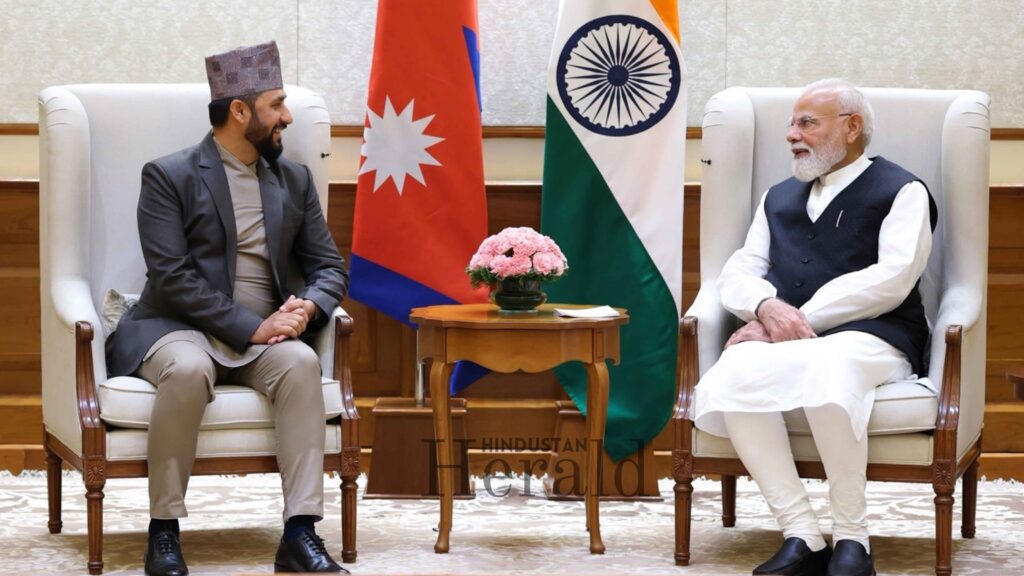
Under the internal arrangement that governs the RSP, Lamichhane and Shah share the party’s authority. A formal seven point agreement signed between them on December 28 last year made Shah the candidate for Prime Minister while Lamichhane retained the chairmanship. In practice, major decisions within the RSP do not get made without Lamichhane’s involvement. He is not background furniture.
India engaging him at this level is a deliberate strategy to maintain a second line of contact into the RSP’s inner circle, separate from whatever the formal state to state relationship with Prime Minister Shah produces. That kind of layered diplomatic engagement is a sign of genuine seriousness. When PM Modi meets RSP Chairman Lamichhane directly, bypassing the formality of waiting for a head of government visit, it tells you that New Delhi is not willing to leave any channel of influence untended.
Lamichhane’s own story is also, frankly, remarkable. He won his first parliamentary seat in Chitwan 2 in 2022, beating established politicians from two major parties in what was seen at the time as a significant upset. He became Deputy Prime Minister and Home Minister in the coalition government that followed.
Then, in January 2023, the Supreme Court cancelled his election entirely, ruling that he had not properly re established Nepali citizenship after giving up his American passport years earlier. Most politicians would have been finished. Lamichhane filed the paperwork, stood again in a by election the following April, and won by a bigger margin than the first time.
More recently, he was detained on allegations of misappropriating funds from Nepal’s cooperative sector. His supporters maintained, forcefully, that the arrest was timed to damage the RSP before the election. He was released, the election happened, and his party won 182 seats.
That arc, from television journalist to Deputy Prime Minister to Supreme Court disqualification to by election comeback to party chairman of the most dominant political force Nepal has seen in a generation, is not a background story. It is the main story. And it is precisely why, when PM Modi met RSP Chairman Lamichhane on Wednesday, the meeting carried a weight that went well beyond the usual diplomatic pleasantries exchanged between neighbouring governments.
India receiving him with the full weight of its foreign policy establishment, legal cloud and all, reflects a pragmatic judgement that the RSP’s democratic mandate matters more than the legal proceedings surrounding its chairman. That is a very deliberate call. And a very Indian one.
Brutal Truth 1 — China Is Already in the Room Whether India Admits It or Not
Every senior official who sat in that meeting room on Wednesday knows that the RSP’s foreign policy vision is not built around India’s comfort.
The party’s manifesto was explicit. “Balanced and dynamic diplomacy” with both India and China. Nepal as a bridge, not a buffer. National interest as the only governing principle for external relations. Foreign Minister Shisir Khanal told the South China Morning Post directly that Nepal’s relationships would be “based broadly on the national interests of Nepal.” Not on history. Not on geography. National interest.
Then in April, Prime Minister Shah invited all 17 ambassadors accredited to Kathmandu to a group meeting at his office. India’s envoy came. China’s envoy came. The United States, Japan, Pakistan, Bangladesh, Qatar, all of them in the same room, at the same time, hearing the same message. Past Nepali leaders had always given India the first and individual meeting. Shah declined to continue that tradition.
As The Print reported, analysts called it a well calibrated diplomatic move. Perhaps. But from where India sits, it is also a quiet statement that Nepal under the RSP will not be taking its relationship with New Delhi for granted, and expects the same courtesy in return.
The honest tension here is that India’s leverage over Nepal has never really been about diplomatic protocol. It runs much deeper than that. Nepal’s economy depends on Indian trade routes, Indian energy markets, and the remittances of millions of Nepali workers who either work in India or travel through it.
The RSP’s ambition to turn Nepal into the hydropower battery of South Asia, targeting 28,500 megawatts of installed capacity by 2035, is entirely dependent on India as the primary buyer and the only realistic transit route for electricity exports to Bangladesh. You cannot export power to Dhaka without going through India first.
As The Diplomat reported recently, this creates what it called a “vulnerability paradox” for Nepal. The more ambitious Nepal’s energy vision becomes, the more structurally dependent it is on Indian cooperation. That dependency does not disappear because the manifesto uses the word “balanced.”
India knows this. The RSP knows India knows this. And both sides are smart enough to understand that the relationship works best when neither side treats that knowledge as a weapon.
The Economics Behind the Diplomacy
The economic context of this meeting deserves more attention than it usually gets in diplomatic coverage. Nepal’s economy is in a difficult moment. The Asian Development Bank projects growth of just 2.7% in fiscal year 2026, suppressed by the political turbulence following last year’s protests and the ripple effects of the ongoing West Asia conflict. That second factor is particularly painful. Roughly 2.5 million Nepali workers are employed in the Middle East. Their remittances, which amount to somewhere between 16% and 25% of Nepal’s entire GDP, are the single largest source of national income. Any sustained disruption in the Gulf sends shockwaves through the Nepali economy almost immediately.
Foreign Minister Khanal acknowledged at the Indian Ocean Conference that the West Asia conflict is not an abstract foreign policy concern for Nepal. He suggested that a major consular evacuation operation could become necessary. The government is, by necessity, focused on that problem right now.
In that context, India’s offer of deeper economic partnership is not just strategically convenient. It is genuinely timely. Nepal currently exports around 1,000 megawatts of electricity to India. It has reportedly proposed increasing that to 4,000 megawatts, with a longer term agreement covering more than 10,000 megawatts over the next decade. Nepal’s total technically feasible hydroelectric potential is estimated at 43,000 megawatts. Almost none of it has been developed.
The business case for deeper India-Nepal energy cooperation is, on its face, overwhelming. India needs clean energy and has committed to ambitious green transition targets. Nepal has some of the most productive river systems in Asia and almost no domestic market large enough to absorb serious industrial scale generation. The pieces fit.
What has historically prevented those pieces from fitting together is not economic logic. It is trust, it is implementation, and it is the tendency of both governments to let broader political friction spill into areas where genuine mutual benefit exists.
Brutal Truth 2 — A Generation of Nepalis Has Not Forgotten What Happened in 2015
There is no honest account of this relationship that skips the 2015 blockade, and there is no honest reading of the RSP’s political base that pretends it is not shaped by that memory.
Nepal was in the middle of recovering from a catastrophic earthquake that killed nearly 9,000 people. It had also just passed a new constitution. India had concerns about that constitution, particularly regarding the rights of the Madhesi community in Nepal’s southern plains, and an unofficial blockade of fuel and goods into Nepal followed. For months, Nepal could not get adequate medicine, cooking gas, or petrol. People suffered in ways that were concrete and visible.
India officially denied responsibility for the blockade. Most Nepalis did not believe that denial then, and a significant number still do not. The episode fundamentally changed something in how Nepalis across the political spectrum think about their southern neighbour. It made the warmth feel conditional in a way it had not quite felt before.
The RSP drew an enormous portion of its support from the generation that came of age during and after 2015. These are not voters with abstract historical grievances. These are voters whose families went without cooking gas for months, who watched their country beg for relief supplies after an earthquake while a border dispute played out in the background. Lamichhane and Shah did not build their movement by being soft on Nepal’s sense of national dignity.
The territorial disputes over Kalapani, Lipulekh, and Limpiyadhura, areas administered by India that Nepal claims as its own territory, are also still formally unresolved. Nepal updated its official map in 2020 to include these areas. India objected. The issue went quiet but did not go away.
None of this appeared in Wednesday’s joint statements. None of it needed to. It was in the room anyway, the way certain things always are when two neighbours with complicated history sit down together and try to talk about the future.
The RSP has not led with these grievances. Its public focus is genuinely on governance, economy, and delivery. That is the window India has right now. But windows close, especially when domestic political pressure builds, and the assumption that the RSP will keep these issues shelved indefinitely is not one India can afford to make.
Brutal Truth 3 — India Has a Well Documented Pattern of Promising and Not Delivering
This is probably the part that nobody in South Block wants written down, but it is the part that matters most for whether Wednesday’s meeting produces anything lasting.
India has a pattern with Nepal. A new government arrives, often with a reset narrative and expressions of goodwill on both sides. India responds warmly. Senior meetings happen. Project announcements follow. Then implementation slows. Then it stalls. Then the Nepali government, facing domestic political pressure to show results, starts making diplomatic gestures toward Beijing that are really messages to New Delhi about what happens when promises do not become reality. Then New Delhi gets anxious. Then senior meetings happen again. Nepal has lived through this cycle with enough regularity that its political class can map it from memory.
The RSP is not built to tolerate that cycle. Lamichhane and Shah built their entire political identity around the idea that Nepal’s old governments talked and did not do. If they sign agreements with India and then explain to their voters for two years that implementation takes time, they will be dismantling the very premise on which they asked for those 182 seats. Their voters came from a tradition that had no patience for exactly this kind of excuse, and those voters are watching. So the stakes of Wednesday’s meeting are not symbolic. They are operational.
Hydropower agreements need transmission lines that get actually built. Trade facilitation needs regulatory frameworks that actually change. The long term 10,000 megawatt electricity deal needs purchase agreements that get honoured on the timelines both sides announce rather than on the timeline that Indian bureaucratic process eventually permits.
Nepal currently exports around 1,000 megawatts to India. It is proposing to increase that fourfold to 4,000 megawatts, according to Business Standard, with ambitions stretching far beyond that. Nepal’s total feasible hydroelectric potential is 43,000 megawatts. Almost none of it is developed. That gap between potential and reality is where India’s reliability as a partner will be tested, not in meeting rooms and not in readouts, but in whether equipment arrives, whether agreements are enforced, and whether the relationship delivers something that a Nepali voter can actually see and feel.
The RSP government, with its mandate and its impatience for visible results, is not going to sit quietly through another cycle of promising openers and slow follow through. If India cannot show up as a reliable partner, the RSP will turn toward whoever will. Not from ideology. From the basic political need to survive its own mandate.
A Room Full of People With a Lot Riding on What Comes Next
Lamichhane flew back to Kathmandu on Wednesday evening with handshakes, photographs, and what both sides will describe in their briefings as a positive and productive exchange.
Back in Kathmandu, a 35 year old Prime Minister with the strongest parliamentary mandate in thirty years is watching to see what India actually does next. Not what it said in the room. What it does next.
The three brutal truths that sat quietly in that meeting, the China question, the 2015 memory, and India’s own delivery record, are not going away. They are the permanent background of this relationship. The question is whether India can work skillfully enough in the foreground to prevent them from becoming the story again.
The people who filled that meeting room on Wednesday are experienced enough to know that the reception was the easy part. The relationship they are trying to build with Nepal’s new government will be tested not by how warmly the statements were worded, but by whether the projects get built, whether the agreements hold, and whether India can be the kind of neighbour that makes Nepal’s bridge ambitions feel achievable rather than naive. India has the opportunity. It has shown up with seriousness. The room was full and the signal was clear. Now comes the harder part. And Nepal has been waiting long enough that it is not in the mood to wait forever.
Stay ahead with Hindustan Herald — bringing you trusted news, sharp analysis, and stories that matter across Politics, Business, Technology, Sports, Entertainment, Lifestyle, and more.
Connect with us on Facebook, Instagram, X (Twitter), LinkedIn, YouTube, and join our Telegram community @hindustanherald for real-time updates.

Tracking world politics, global markets, trade movements, policy decisions, and the changing balance of economic power.
- Shelesh Joshi

- Shelesh Joshi
- Shelesh Joshi
- Shelesh Joshi



Specializes in South Asian geopolitics and global diplomacy, bringing in-depth analysis on international relations.
- Rajiv Menon
- Rajiv Menon
- Rajiv Menon
- Rajiv Menon