
 By Arun Upadhayay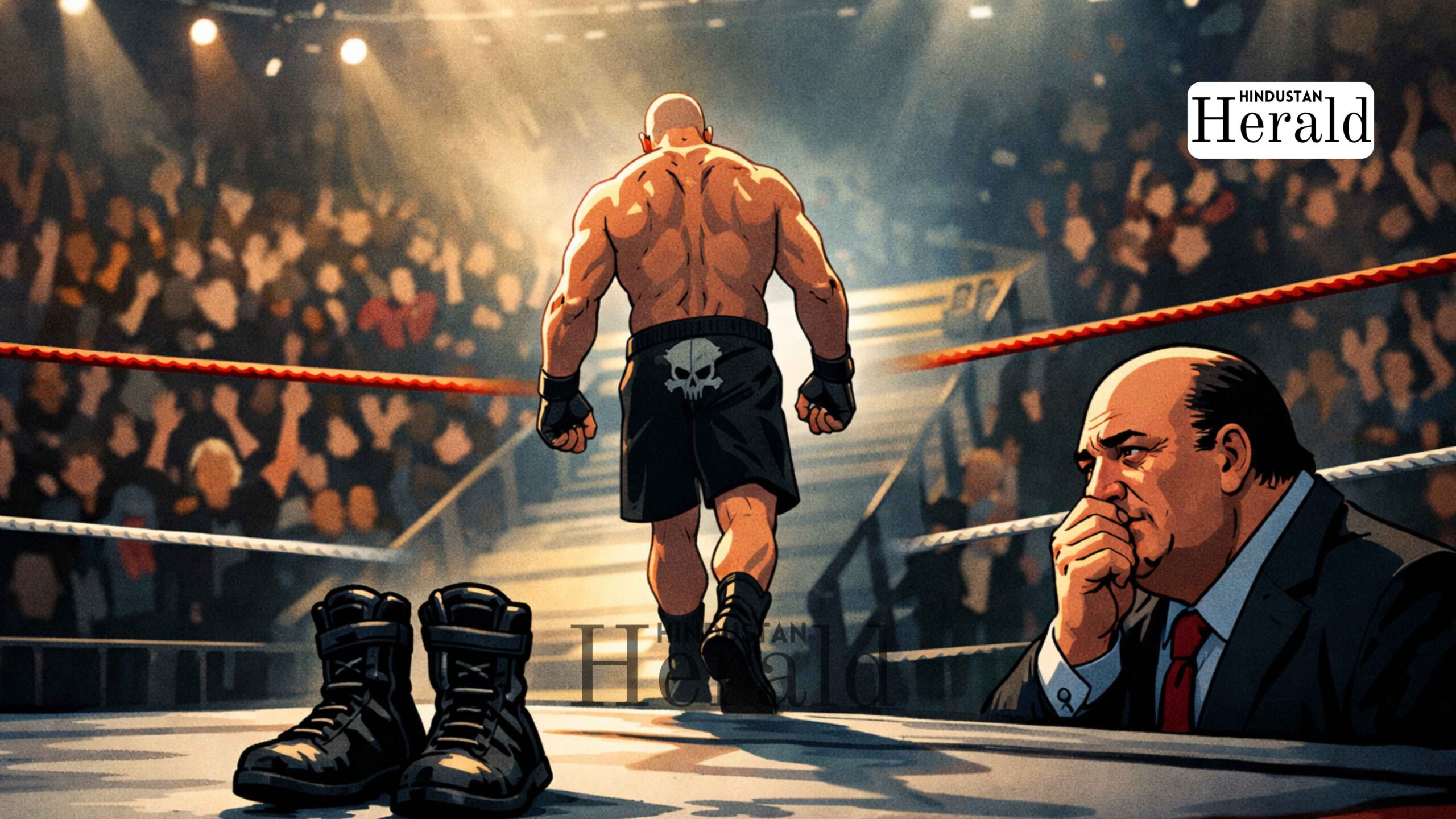
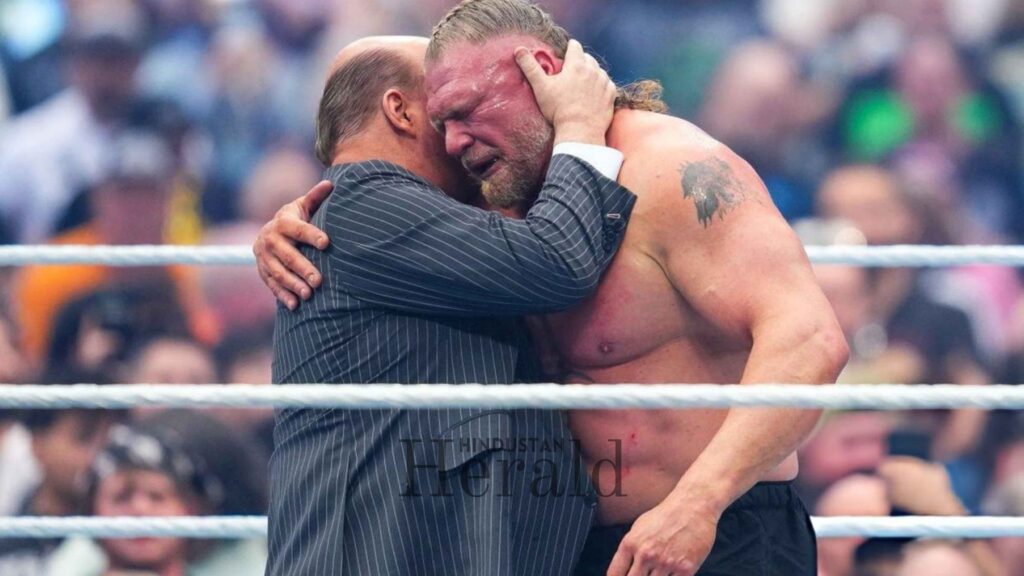
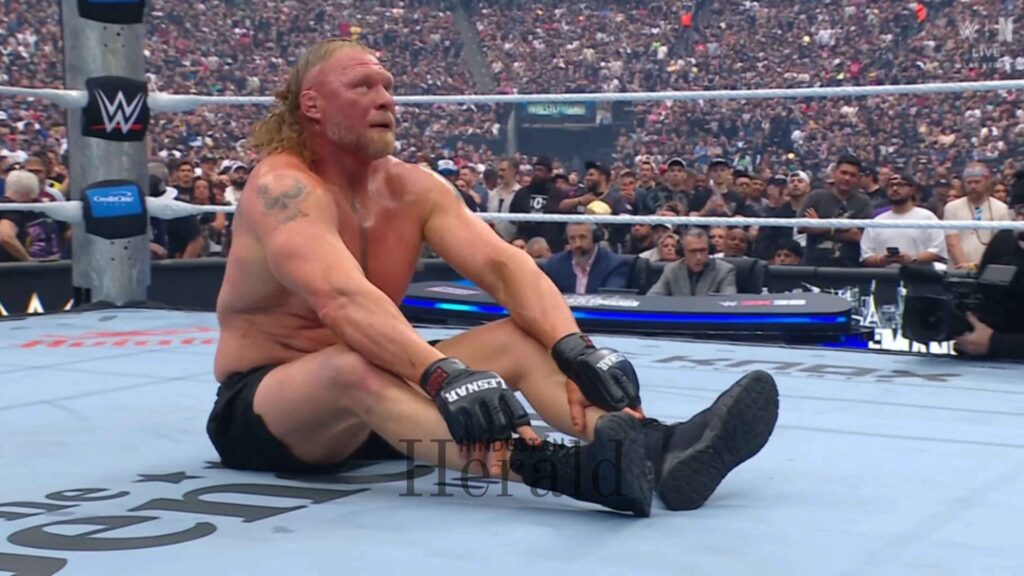
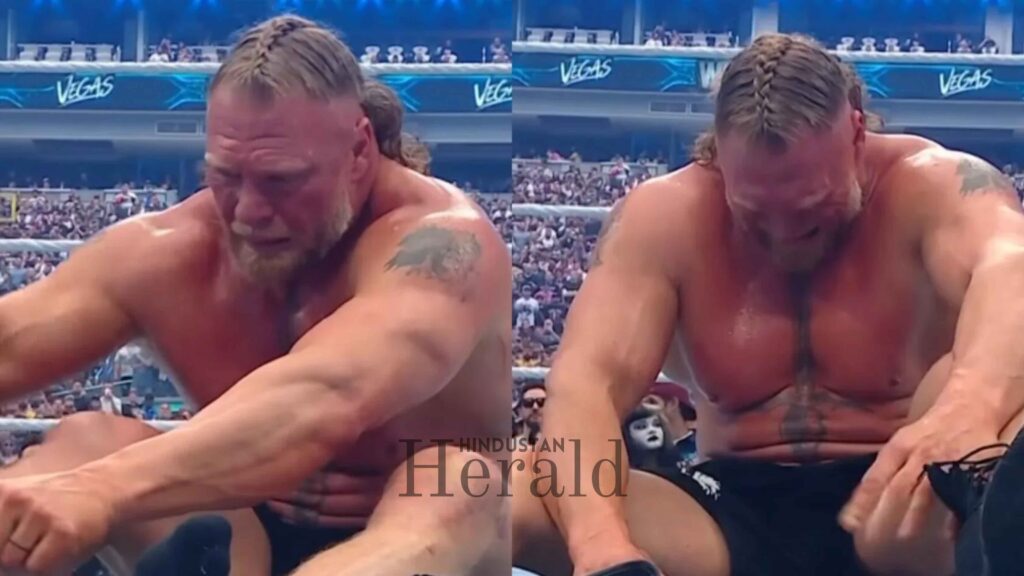
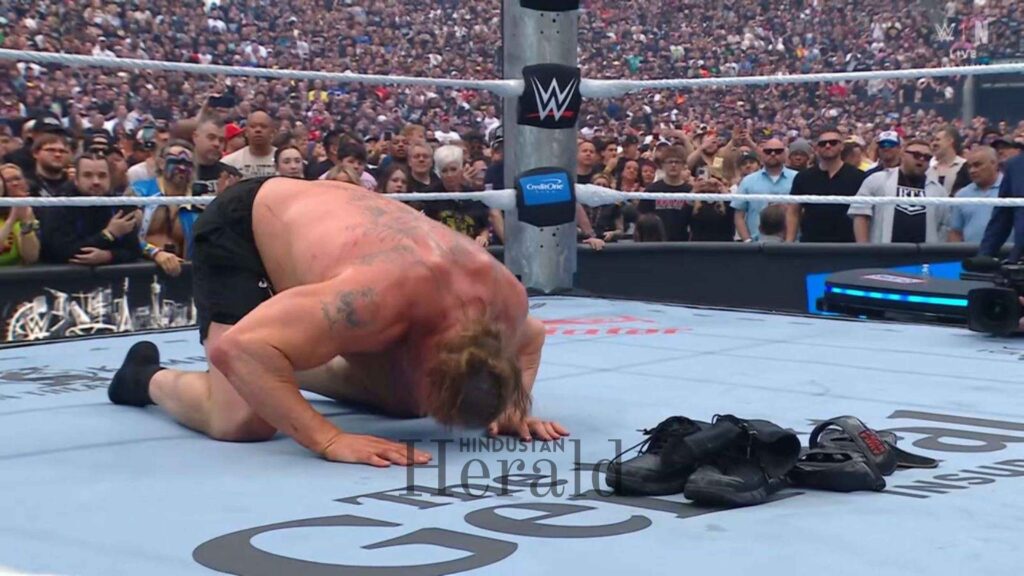
New Delhi, April 20: Right. So this is how it ended. Not with a big retirement speech. Not with confetti falling from the ceiling or some emotional video package rolling on the big screen. Brock Lesnar lost a wrestling match on Sunday night, sat down in the ring, took his boots off, put them on the mat, hugged Paul Heyman, and walked away while the crowd lost their minds chanting his name.
That was it. That was the ending.
No official announcement from WWE yet. Nothing confirmed in writing. But when a fighter leaves his boots and gloves in the centre of the ring, you do not need a press release to understand what just happened. That gesture comes from amateur wrestling. It is what athletes do when they are done. Everyone in that building in Las Vegas on Sunday night understood it immediately.
Brock Lesnar is, in all likelihood, retired.
For twenty-four years, this has been going on. Twenty-four years of championships, shocks, career pivots, comebacks, and moments that people who watched them will never fully stop talking about. So let us go through the whole thing properly, from the very beginning.
Just a Big Kid From a Small Town
Webster, South Dakota, is not a place most people could point to on a map. Population of a few thousand, a farming community, in the middle of nowhere in the best possible sense. That is where Brock Edward Lesnar grew up, born July 12, 1977, into a family with absolutely zero professional sports connections.
What he did have was size. And strength. And the kind of raw athletic ability that coaches recognise immediately and spend the rest of their careers trying to explain.
He got into wrestling at school, which in America at the high school and college level is a completely serious competitive sport, nothing like the WWE stuff, pure physical grappling against opponents trying equally hard to pin you. Turns out Lesnar was exceptional at it. Exceptional enough to get a scholarship to wrestle for the University of Minnesota.
He went there, trained hard, finished second in the entire country in 1999, came back the next year and won the whole thing. NCAA Division I heavyweight national champion, 2000. That is the highest level of collegiate wrestling in the United States. He was the best in the country at 22 years old.
WWE had people watching him wrestle in college. Before he even graduated, they were already talking to him about signing. He joined up shortly after and the whole mad story began.
Debut on a Monday Night, Champion by August
March 18, 2002. Monday Night Raw. Brock Lesnar walks down to that ring for the first time on national television, Paul Heyman right beside him, and just starts dismantling everyone in sight.
The crowd did not know who he was. They worked it out.
Heyman kept calling him “The Next Big Thing” on the microphone. That sounds like typical wrestling hype. With Lesnar, it was just an accurate description. He was 24 years old, built like something that should not be able to move that fast, and technically so much better than almost everyone on that roster that it was honestly a bit unfair to watch.
Five months after that debut, he pinned The Rock at SummerSlam and became WWE Champion. Twenty-five years old. Youngest champion in the history of the company at that point.
The arena went quiet for a second after that pinfall. That particular kind of quiet that happens when something the crowd expected occurs but still cannot quite believe it actually happened.
From there he just kept going. Won King of the Ring in 2002. Won the Royal Rumble in January 2003. Main-evented WrestleMania XIX that April against Kurt Angle and walked out with his second championship, despite attempting a shooting star press off the top rope mid-match, a high-flying move that a nearly 300-pound man should not be doing under any circumstances, nearly landing on his head, and then winning anyway because of course he did.
His whole rivalry with Kurt Angle during those two years was something special. Technical wrestling, real intensity, matches that held up at the time and still hold up now. Their 60-minute Iron Man match on SmackDown in September 2003 won Match of the Year. Go look it up if you have not seen it.
Two years in professional wrestling and the man had already done more than most do in a full career. So naturally, he walked away.
He Quit Wrestling to Try American Football. Then MMA. Won Both.
After WrestleMania XX in early 2004, Lesnar left WWE. Just up and left. Said he wanted to try out for the NFL.
He had not played organised football since high school. He was 26. Everyone thought he had lost the plot.
The Minnesota Vikings gave him a shot in the preseason. He did not make the final roster. They let him go.
Most people in that situation come back with their tail between their legs. Lesnar looked at MMA instead.
Getting into the UFC was not straightforward either. Dana White reportedly had zero interest in signing him. Lesnar could not even get his calls returned. So he tracked White down at a live event, walked up to him in person, shook his hand, told him who he was, and asked for a shot. White, somewhat reluctantly, gave him one fight to see what he could do.
He lost that debut against Frank Mir. Submission in the first round. People who had been sceptical of the whole experiment felt vindicated.
Nine months later, Brock Lesnar defeated Randy Couture for the UFC Heavyweight Championship.
That needs repeating. Nine months after losing his first professional MMA fight, he was the UFC heavyweight champion of the world. Couture was not an easy opponent. He was a legend of the sport, a multiple-time champion, and an experienced and respected fighter. Lesnar walked through him.
He unified the championship in 2010 against Shane Carwin in a fight that genuinely looked like it might go badly for Lesnar early on. He was rocked in the first round. He took real damage. He survived, turned it around, and finished the fight in the second round.
That is the thing about Lesnar that statistics alone do not capture. He had this quality of absorbing a bad situation and coming out the other side of it anyway.
Diverticulitis eventually did what no opponent could. It is a painful condition affecting the digestive system, chronic, recurring, and completely disruptive to athletic performance at the highest level. It knocked him out at his peak. He lost to Cain Velasquez. Lost to Alistair Overeem. Retired from MMA in 2011.
In between all of this, somewhere around 2005, he had also gone to Japan, signed with New Japan Pro-Wrestling, and won the IWGP Heavyweight Championship there as well. Just casually adding another major title from another continent to the collection.
Back to WWE. And Then the Night Nobody Saw Coming.
Lesnar came back to WWE in 2012. He was 34 at this point, had been through the NFL rejection, the UFC run, the health issues, and a brief retirement from everything. He returned not as a full-time performer doing weekly television but as a special attraction. Big matches, big moments, limited appearances.
It worked because every time he showed up felt like an event.
But nothing from this second run prepared anyone for what happened at WrestleMania XXX in New Orleans, April 2014.
The Undertaker’s WrestleMania streak was, at that point, 21-0. Twenty-one years of going undefeated at the biggest show of the year. Every single WrestleMania, The Undertaker won. It had survived Stone Cold Steve Austin, Triple H, Shawn Michaels coming back for a second try, Randy Orton, CM Punk, everyone. People had stopped seriously believing it could end. It had become just a fact of the wrestling world, like gravity.
Brock Lesnar ended it.
When that three-count happened, the building in New Orleans went silent. Genuinely silent. Not polite quiet, not the quiet of a crowd transitioning between reactions. Silent like the air had been pulled out of the room. People sat in their seats not moving. The announcers on television said almost nothing. There is footage of fans just staring, completely blank, unable to process it.
It is still probably the single most shocking moment in professional wrestling in the last twenty years. Possibly longer.
That win launched Lesnar into what became one of the most dominant championship runs the company had seen in decades. He beat John Cena at SummerSlam 2014 in a title match that was borderline uncomfortable to watch. Cena, who had been the face of WWE for years, was made to look completely outclassed. Lesnar won the title and held it for months, turning up only for pay-per-view events and leaving weekly television without its champion.
The criticism was fair. The ratings and crowd reactions every time he appeared were also fair evidence that his value was enormous, regardless of how often he showed up.
He became WWE Universal Champion three separate times. First time at WrestleMania 33 in April 2017. He won Money in the Bank in 2019. Won his second Royal Rumble in 2022. Headlined WrestleMania five times total across his career. Held 12 world championships across major promotions by the end. Fifteen championship reigns when you count everything across every organisation.
The Last Match
Going into this weekend, there had been some talk. Fightful, which tends to have reliable backstage information, had reported that plenty of people inside WWE expected Lesnar to have his formal retirement moment at SummerSlam in Minneapolis this summer, which would have made sense geographically given his Minnesota connections.
That did not happen, or if it was the plan, the plan changed on Sunday night in Las Vegas.
Oba Femi is 23 years old, 6 feet 6, 330 pounds, and has been one of the most talked-about young wrestlers in the company. Lesnar issued an open challenge on Raw back in February, and Femi accepted it. On paper, it was the old monster versus the new one.
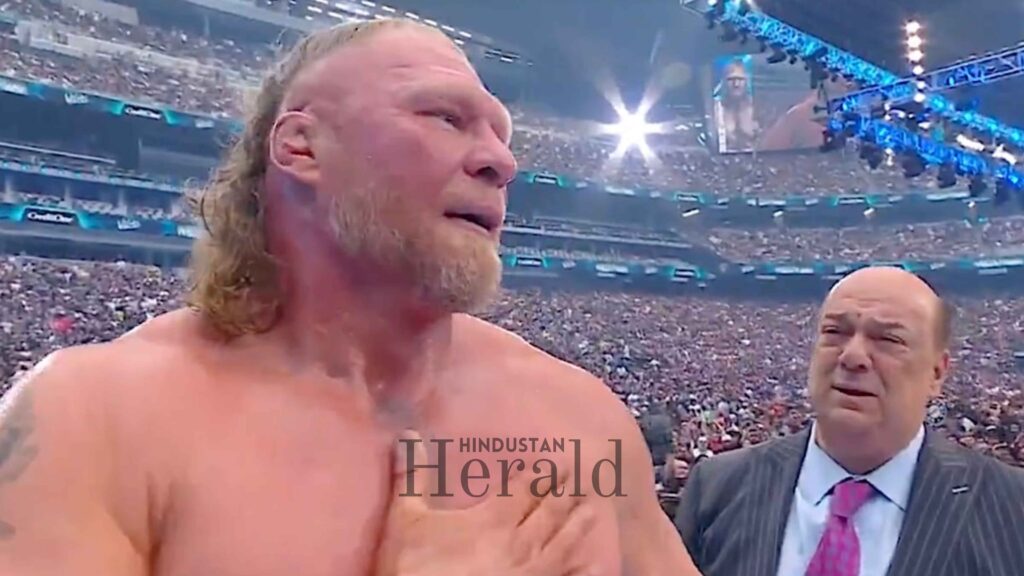
Femi won clean. His finishing powerbomb, the Fall from Grace, got the three-count. Lesnar, at 48, lay on the mat and then slowly sat up.
What happened over the next few minutes was not scripted in the way most things at WrestleMania are. Or if it was, it was scripted with enough truth in it that the difference did not matter.
Lesnar took his gloves off. Took his boots off. Set them in the middle of the ring. Stood up and just looked at the crowd for a moment. Paul Heyman, who has been there for almost all of this, who was there on that first Raw in 2002, calling him the Next Big Thing, walked into the ring and raised his hand. The crowd chanted “Thank you, Brock” loud enough that it echoed.
The big man was crying.
He walked out. That was Sunday night.
What Does All of This Actually Mean
Here is the honest answer. Nobody will ever do what Brock Lesnar did. Not because of the titles, though the titles are extraordinary. Not because of the physical gifts, though those were genuinely rare.
It is because of the combination of everything, and the attitude underneath all of it.
He was willing to leave the biggest wrestling company in the world to try American football when he was already a champion. He was willing to lose his UFC debut and come back anyway. He was willing to absorb punishment, battle a chronic illness, lose titles, go away, and return every single time with the same intensity he had on the first day.
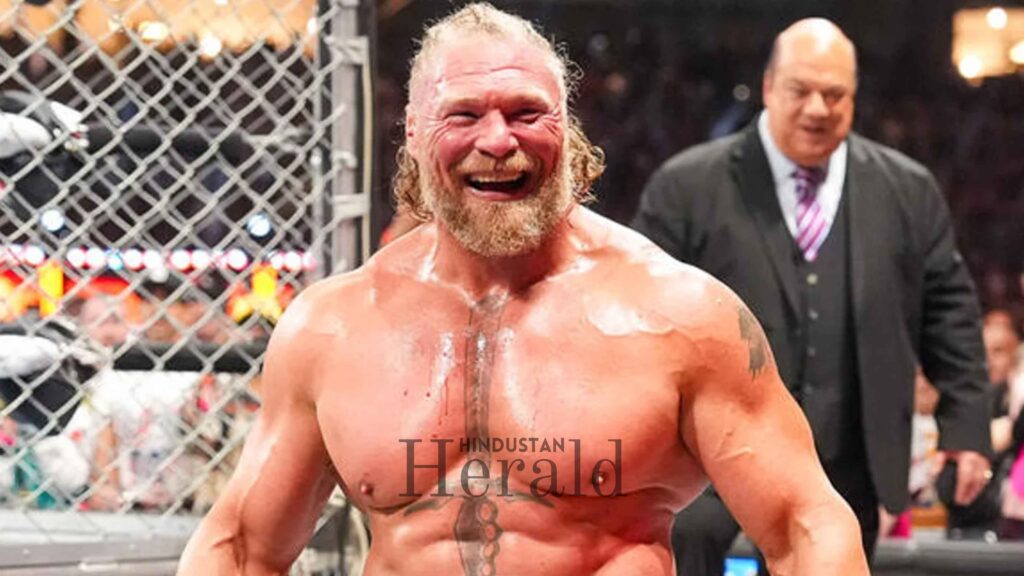
He is the only person alive who can say he held the top heavyweight championship in the WWE, the UFC, New Japan Pro-Wrestling, the Inoki Genome Federation, and the NCAA all at different points in his career. Those are five completely different competitive environments across multiple continents and multiple sports. He won at the top level in all of them.
When you put that alongside everything he did in professional wrestling specifically, the WrestleMania streak ending, the squash of Cena, the rivalry with Angle, the five WrestleMania main events, it becomes a career that simply does not fit into any normal framework for how careers are supposed to go.
He turns 49 in July. The boots are on the mat in Las Vegas. Paul Heyman is still probably somewhere telling people Brock will be back in fifteen years, because that is exactly the sort of thing Paul Heyman would say.
Maybe. In this business, you never say never.
But on Sunday night in Las Vegas, in front of 60,000 people who gave him a standing ovation after he had just lost, Brock Lesnar from Webster, South Dakota, looked like a man who had said everything he needed to say.
Good career, mate. Good career.
Stay ahead with Hindustan Herald — bringing you trusted news, sharp analysis, and stories that matter across Politics, Business, Technology, Sports, Entertainment, Lifestyle, and more.
Connect with us on Facebook, Instagram, X (Twitter), LinkedIn, YouTube, and join our Telegram community @hindustanherald for real-time updates.

- Arun Upadhayay

- Arun Upadhayay
- Arun Upadhayay
- Arun Upadhayay


 Ayesha Khan