
 By Shelesh Joshi and Kavita Iyer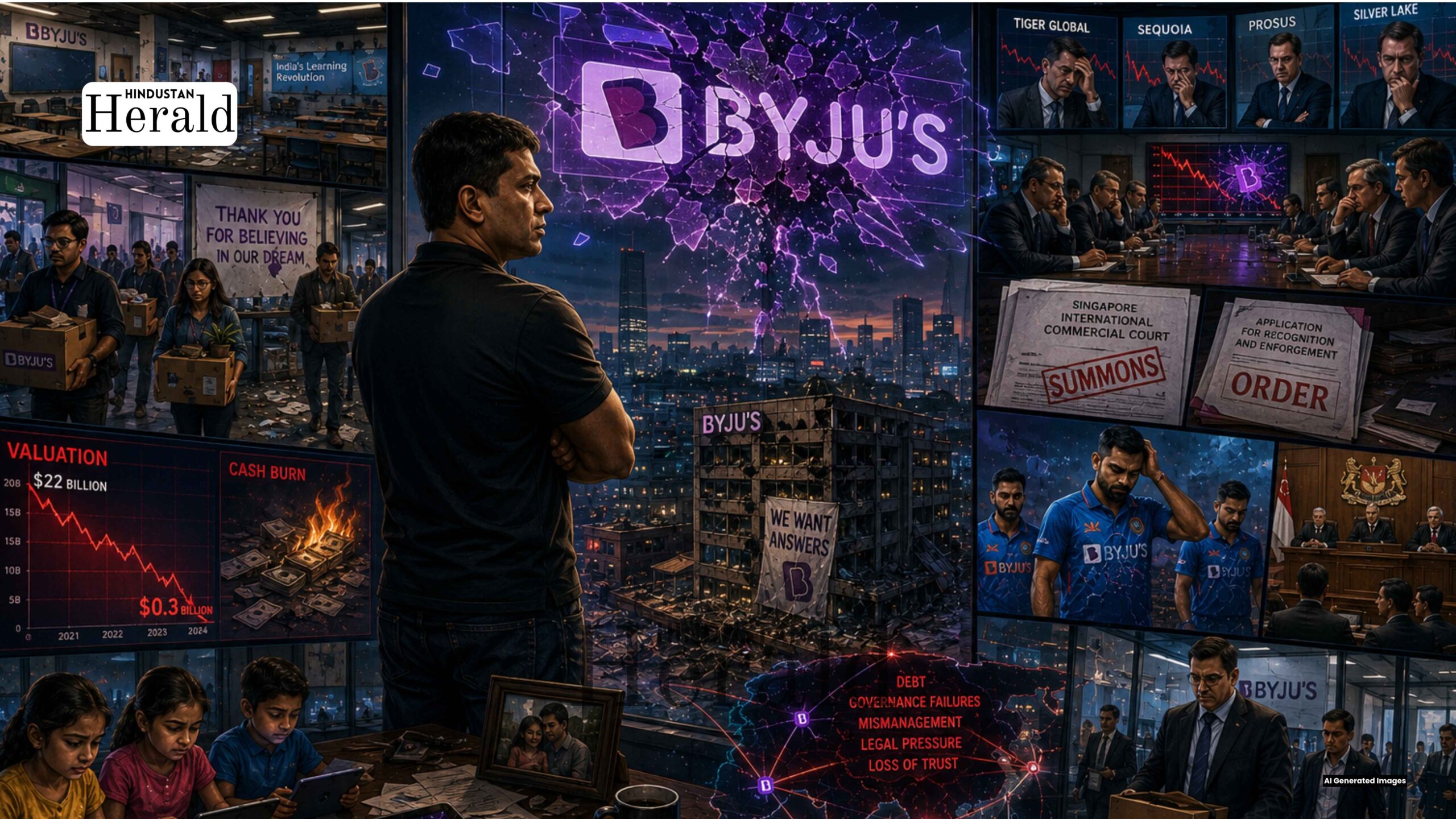
New Delhi, May 27: Sometime in 2022, if you were boarding a flight out of any major Indian city, there was a decent chance you would spot an advertisement for BYJU’S. On the back of the seat in front of you. On the tray table. Maybe on a banner outside the gate. The company was everywhere on television, on hoardings, on the chests of Indian cricketers, in the conversations of every venture capitalist who passed through Bengaluru.
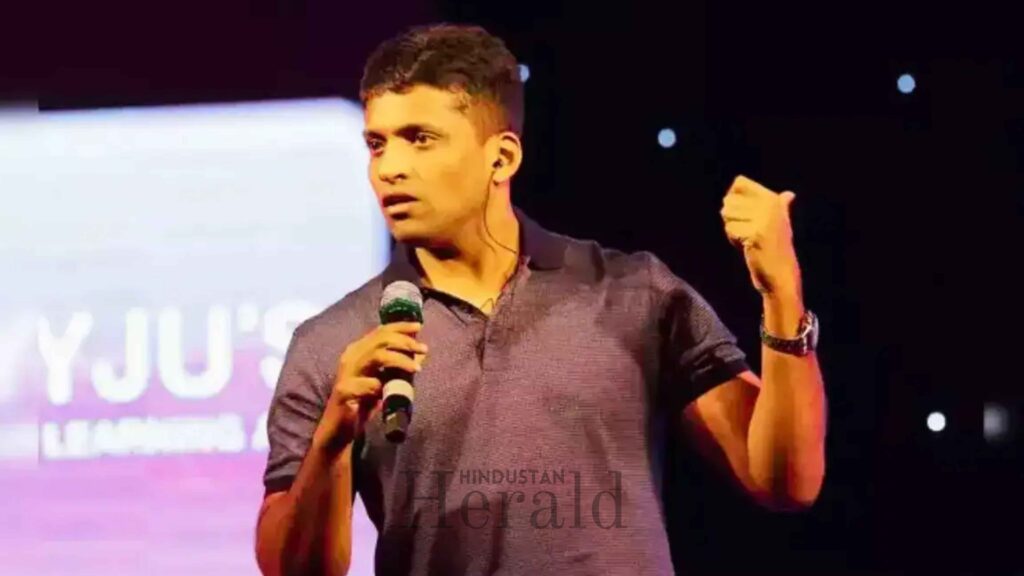
Byju Raveendran, the man who built it, had become one of those rare figures in Indian business who crossed over into something like national mythology. A teacher’s son from a small town in Kerala’s Kasaragod district. No IIT, no IIM, no family money. Just a gift for explaining things and, eventually, a company valued at 22 billion dollars.
This week, a Singapore court sentenced him to six months in prison.
He was not convicted of fraud. The charge is contempt of court meaning a judge ordered him to hand over financial records related to a creditor dispute, and he did not do it. That detail matters. Because in a way, it captures something about how this entire story unfolded. Raveendran did not just build a company that failed. He built a company where, when things went wrong, the instinct was to stonewall, to delay, to move money around, and to treat legal obligations as negotiable. The Singapore court has now said, formally, that they are not.
Quick Summary
- A Singapore court sentenced Byju Raveendran to 6 months in prison for contempt of court making him the highest profile Indian startup founder to face jail time abroad.
- The case centres on a $1.2 billion loan taken in 2021, from which lenders allege $533 million was moved into family linked accounts to shield it from creditors.
- BYJU’S peaked at a valuation of $22 billion in March 2022 the highest ever for an Indian startup backed by SoftBank, Tiger Global, and the Chan Zuckerberg Initiative.
- Audited accounts filed 18 months late revealed a net loss of Rs 8,245 crore (~$990 million) for FY2022, more than double earlier estimates. Auditor Deloitte resigned shortly after.
- By late 2023, BYJU’S had stopped paying salaries across much of a 50,000 strong workforce, with hundreds of grievances filed with the Karnataka Labour Department.
- The BCCI triggered formal insolvency proceedings in July 2023 over unpaid sponsorship dues of Rs 158 crore the same jersey deal that once put BYJU’S on Indian cricket.
What the Singapore Case Is Actually About
The legal trouble in Singapore grew out of a loan that BYJU’S took in late 2021, when the company was still being treated as untouchable.
The borrower on paper was BYJU’S Alpha Inc., a Delaware registered subsidiary. The lenders were a group of US based institutional investors. The amount was $1.2 billion, structured as a Term Loan B facility. The stated purpose was international expansion funding acquisitions and building out the company’s presence in markets outside India.
By 2023, those lenders had turned hostile. They alleged that roughly $533 million had been moved out of BYJU’S Alpha through a series of wire transfers, into accounts that ended up at a Florida based fund called Camshaft Capital Fund. The lenders, represented by Glas Trust Company LLC, argued this was not a legitimate business transaction. They said it was an attempt to put money beyond the reach of creditors.
The Wall Street Journal reported on those transfers at the time, and the reporting was detailed enough that it set off proceedings in multiple jurisdictions at once. A US federal court in Delaware issued freezing orders. Raveendran’s brother, Riju Raveendran, who ran international operations, was named in civil proceedings in America.
In Singapore, the Singapore International Commercial Court took up the creditor dispute and issued orders requiring Byju Raveendran to cooperate fully to disclose records, to explain the money movements, to engage with the process. According to sources cited by Business Standard, he did not comply. The contempt proceedings followed. And now, the sentence.
His lawyers had not released a statement when this report was being written. He can still appeal or seek a stay, but any such effort will require him to do exactly what the court originally asked him to do show up and engage.
You Have to Understand What This Company Was
People who have not followed BYJU’S closely sometimes assume this was always a scam dressed up as an edtech company. That reading is too simple, and it misses the more interesting and more troubling truth.
Raveendran genuinely understood how students learn. His original teaching method before there was an app, before there was a valuation, when he was just a young guy holding weekend sessions in auditoriums across Bengaluru worked. Students who took his CAT preparation classes passed at unusually high rates. He had a way of reaching people who had switched off in school, of making mathematics feel like something you could actually think through rather than just memorise.
The BYJU’S learning app, when it launched in 2015, carried some of that quality. It was one of the first Indian edtech products that students sought out voluntarily. Not because their parents made them, not because their schools required it, but because it was genuinely easier to understand something after watching a BYJU’S video than after reading a textbook chapter. That reputation spread fast, and the early user numbers were real.
The investors who came in from 2016 onwards were not naive people. Sequoia Capital India, Tiger Global, SoftBank Vision Fund, the Chan Zuckerberg Initiative, the Qatar Investment Authority these are institutions with considerable experience evaluating companies. They saw the engagement data. They saw the growth curves. They believed, for a time, that BYJU’S could become the dominant education platform not just in India but globally. By March 2022, they had collectively pushed the valuation to $22 billion.

That was when the acquisition binge was in full swing. Aakash Educational Services went for nearly $950 million. WhiteHat Jr, a platform that taught children to code, cost $300 million. Great Learning, focused on professional upskilling, was another $600 million or so. Overseas, Tutor.com and Tynker were added to the portfolio. In total, the company burned through an estimated $2.5 billion on acquisitions in roughly three years.
The logic Raveendran offered investors was that the education market was about to consolidate, that the winner would take most of the value, and that moving slowly meant being left behind. It was the kind of argument that sounds compelling when you are sitting in a room where everyone else already believes it.
The Accounts Were the First Honest Thing
In September 2022, BYJU’S missed the deadline to file its audited financial results for the year ending March 2022. The explanation given was a change in how the company recognised revenue. That was technically true but also somewhat misleading about how serious the problem was.
When the accounts were eventually filed nearly 18 months after they were due they showed a net loss of Rs 8,245 crore for that single year. In dollar terms, close to $990 million. Analysts had been estimating losses in the range of Rs 3,000 to 4,000 crore. The actual figure was more than double. The gap existed largely because BYJU’S had been booking multi year subscription revenue upfront, which made its earlier reported numbers look healthier than the business actually was.

Two months after those accounts came out, Deloitte resigned as statutory auditor. Three independent directors quit at the same time. None of them issued detailed explanations. They did not need to. When a firm of Deloitte’s reputation walks out of an audit mid process, the message is clear enough to anyone paying attention.
By the end of 2023, the company had stopped paying salaries to large portions of its workforce. BYJU’S had at its peak employed close to 50,000 people. Many of them spent months waiting for wages that never came. The Karnataka Labour Department received hundreds of formal complaints. These were not abstract corporate failures they were people in Bengaluru and Hyderabad and Delhi who had rent to pay and families to feed and no answers from a management that had gone quiet.
The BCCI the cricket board that had taken BYJU’S money for years to put the company name on the national team’s jersey filed a petition before the National Company Law Tribunal to recover unpaid sponsorship dues of around Rs 158 crore. The NCLT admitted the case in July 2023 and kicked off insolvency proceedings under the Insolvency and Bankruptcy Code.
For a while, a court appointed resolution professional took formal control of Think and Learn Private Limited. It was a remarkable scene one of the country’s most celebrated founders effectively sidelined by a statutory process. Raveendran challenged the arrangement before the Supreme Court of India, reached a settlement with the BCCI, and clawed back some operational authority. But by that point, the app had lost a substantial chunk of its user base, the brand was seriously damaged, and the company had no obvious path back to its former position.
The Problem With Running a Company Like a Family Affair
One of the recurring criticisms of BYJU’S, even from people who were initially supportive, was that the company was run less like a professionally governed institution and more like a family business that happened to have institutional money in it.
Raveendran’s wife, Divya Gokulnath, served as co founder and handled significant public facing responsibilities. His brother, Riju Raveendran, ran international operations and is the figure at the centre of the US proceedings involving the wire transfers. Decisions that should have gone through independent board review reportedly moved through a far tighter circle.
Board members who raised questions, according to accounts in The Economic Times and Mint over the past two years, did not last long. The independent directors who eventually resigned in June 2023 left without fanfare, but their departure, combined with Deloitte’s exit, told a story the numbers alone might not have conveyed clearly enough: the oversight structures at BYJU’S had not been functioning in any meaningful sense.
This matters beyond BYJU’S specifically. The company was not operating in obscurity. It had received money from some of the most sophisticated investors in the world. It had over a hundred million registered users. It was a nationally recognised brand. And still, the governance failed comprehensively, and it failed for years before the external consequences became impossible to ignore. That should make regulators uncomfortable, because it suggests the current framework for monitoring large private companies is not working.
Where This Leaves India’s Rules Around Big Private Companies
The Securities and Exchange Board of India and the Ministry of Corporate Affairs have been circling this question for a couple of years now. Under current law, a privately held company even one the size BYJU’S was at its peak is not required to make the same level of disclosures as a listed firm. It does not have to publish quarterly results. Its financial statements do not get the same degree of public scrutiny. The assumption built into the law is that private companies are accountable primarily to their investors, not to the broader public.
BYJU’S broke that assumption in every direction. Its employees were a public constituency. Its student subscribers many of them children from middle class families who had taken loans to pay for multi year packages were a public constituency. Its creditors were international institutions. When it collapsed, the damage spread well beyond the investor group.
The NCLT, the Enforcement Directorate, and the Serious Fraud Investigation Office have all been involved in various aspects of the BYJU’S investigation at different points. The fact that a Singapore court has now added a custodial sentence to this picture gives Indian lawmakers a hard, concrete example to point at when the debate over tightening disclosure norms for large unlisted companies comes back to the floor.
Whether that debate results in actual legislation is a separate question. But the political cost of continuing to do nothing is higher than it was in 2022, and that shift alone may be enough to move things.
The Sector Is Alive, But It Learned a Painful Lesson
Indian edtech is not dead. The pandemic years inflated expectations to an unsustainable level, but the underlying demand for quality education, test preparation, and skills training has not gone anywhere. upGrad has found a workable model in professional education. Eruditus has built something durable through its university partnership approach. Neither of them tried to do everything at once.
Aakash Educational Services, the test prep chain that BYJU’S bought for nearly a billion dollars and that still operates hundreds of centres around the country, is probably the most valuable thing left in the BYJU’S portfolio. The brand has genuine standing among students preparing for NEET and JEE. The teaching quality, separated from the chaos of the parent company, is reportedly intact. Private equity investors are said to be looking at it, though nothing has been finalised.
What Aakash becomes next will be one of the more closely watched transactions in Indian education. If it finds the right ownership, it could have a second life. If it gets swept further into the legal mess around Think and Learn, that outcome is less certain.
The Part That Is Not Over
Raveendran is facing six months in Singapore and a decision about whether to appeal. That legal process will play out on its own timeline.
Back in India, the NCLT proceedings have not concluded. Creditors are still waiting. Former employees have filed claims that remain unresolved. Students who paid for subscriptions and got nothing are still in the queue. The Singapore verdict settled one question about one man’s conduct in one jurisdiction. It did not settle any of the underlying financial claims that have been piling up since 2023.
There is something worth sitting with in all of this. Raveendran was not a con artist who stumbled into education. He was a genuinely talented teacher who built a product people wanted, attracted serious investors, and then made choices about acquisition pace, about governance, about transparency, about how to treat a court order that destroyed everything he built, along with the savings, salaries, and subscriptions of people who had trusted him.
That is not a simple story. It is not a story about a villain. It is a story about what happens when the systems designed to prevent this kind of collapse board oversight, auditor independence, regulatory disclosure, legal compliance are treated as obstacles rather than foundations.
India has seen this story before, in different industries and at different scales. The question the BYJU’S case puts on the table, directly and with considerable force, is whether this country is willing to build those foundations properly this time around. Or whether it will wait for the next one.
For the students who signed up believing in the promise, for the teachers who joined thinking they were part of something that mattered, and for the parents who paid for subscriptions out of family budgets that had little room for error the least they are owed is an honest answer to that question.
Stay ahead with Hindustan Herald — bringing you trusted news, sharp analysis, and stories that matter across Politics, Business, Technology, Sports, Entertainment, Lifestyle, and more.
Connect with us on Facebook, Instagram, X (Twitter), LinkedIn, YouTube, and join our Telegram community @hindustanherald for real-time updates.

Tracking world politics, global markets, trade movements, policy decisions, and the changing balance of economic power.
- Shelesh Joshi

- Shelesh Joshi
- Shelesh Joshi
- Shelesh Joshi





Former financial consultant turned journalist, reporting on markets, industry trends, and economic policy.
- Kavita Iyer
- Kavita Iyer
- Kavita Iyer
- Kavita Iyer



 Ananya Sharma and Kavita Iyer
  Arun Upadhayay