
 By Sandeep Verma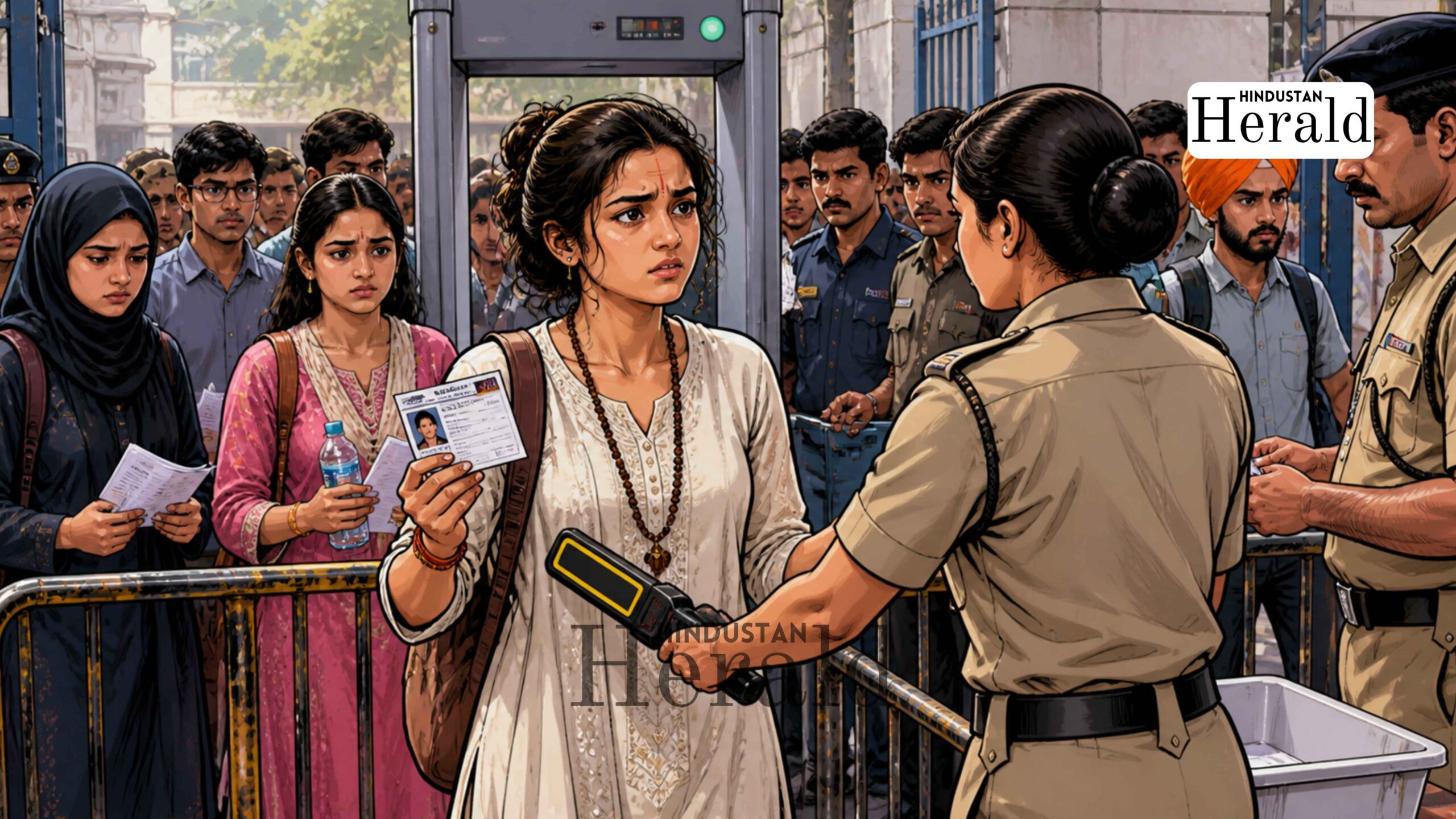
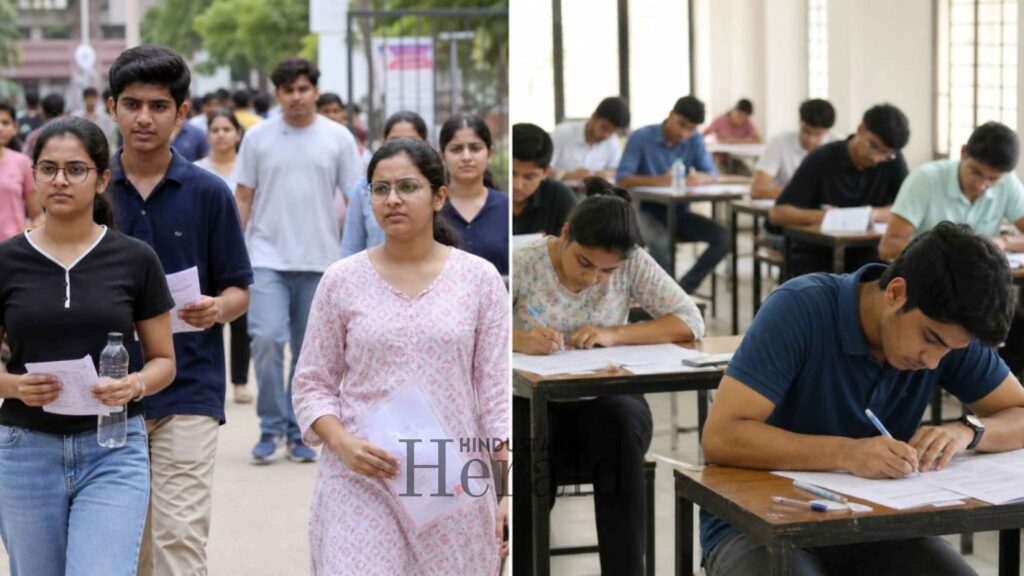
New Delhi, May 4: A medical entrance examination is supposed to be about one thing only, the merit of the student sitting behind the answer sheet. But on Sunday, May 3, the day more than 22 lakh aspirants across India sat down for the NEET UG 2026, it was events outside the examination hall that grabbed the loudest attention. Two videos from two different states went viral within hours, and together, they set off a debate that went far beyond exam-day protocols. At the centre of it all: religious symbols, dress codes, and a question about fairness that India has grappled with for years.
What Happened at the Surat Exam Centre
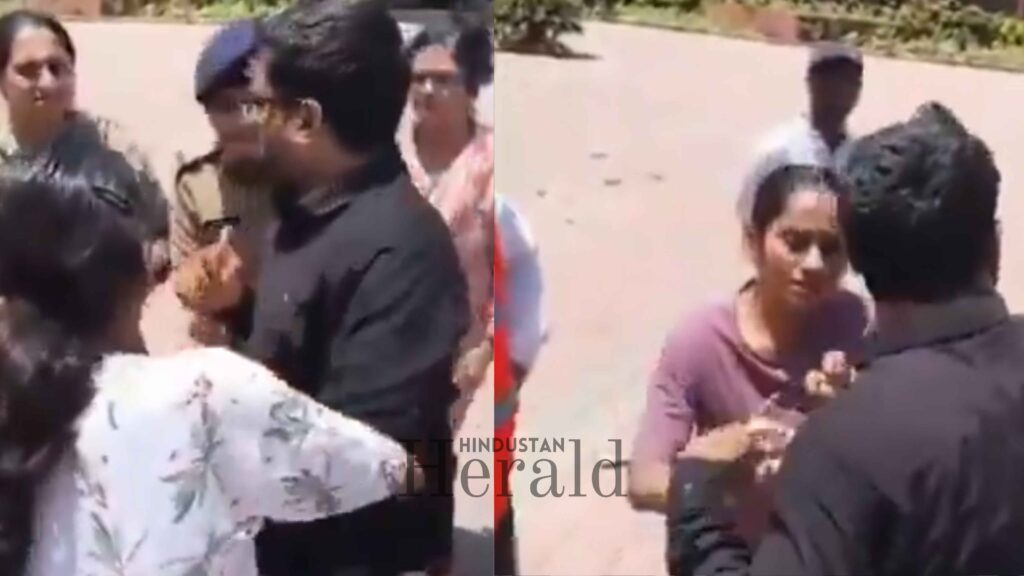
The incident that triggered the sharpest reactions took place at the Amroli examination centre in Surat, Gujarat. According to accounts from the venue and videos shared widely on social media platform X, a Hindu girl appearing for NEET UG 2026 was asked by frisking staff to remove her Kanthi-Tulsi mala, a sacred necklace made of holy basil seeds, before she was permitted to enter the hall.
What began as a routine security check at the Amroli centre quickly turned into a heated argument after the student was allegedly asked to remove her Kanthi-Tulsi mala before entry.
Her father, who had accompanied her to the centre, refused to accept the instruction quietly. In the video, he is heard arguing with school staff and security personnel, insisting that the necklace was a religious symbol and had no business being treated like a prohibited accessory. He said at one point, “Why did they make her remove the kanthi? She will not remove it.” As officials tried to explain that it was part of examination protocol, he continued to protest, saying, “You are spoiling her exam. Why only the kanthi?”
As the argument grew louder and the situation tensed, the father stepped outside the gate and addressed those recording on camera. He is heard saying he is a proud Hindu standing in Surat, not in Pakistan, and demanding to know why his daughter’s sacred thread was being treated differently from other religious coverings permitted entry. Initial reports suggest the student was eventually allowed to appear for the examination. But by then, the damage to the family’s examination morning and to public trust had already been done.
The Barmer Comparison That Fuelled the Fire
The Surat video alone would have been enough for a heated social media cycle. But it was the second video, this one from Barmer in Rajasthan, that gave the controversy its communal sharpness.
A candidate wearing a burqa was checked during the NEET exam but was still allowed to keep it on in Barmer, Rajasthan after showing her face, she was permitted to enter. Placed side by side with the Surat video, the contrast became a talking point that thousands amplified across platforms, with many arguing that the National Testing Agency (NTA) was applying its rules with a selective hand.
Over 85,000 candidates from Gujarat appeared for NEET UG on May 3. Across the country, more than 22 lakh students sat for one of the country’s most competitive medical entrance examinations. The exam was conducted across 552 cities in India and 14 international locations. In that scale, isolated centre-level decisions can quickly take on a national life of their own.
What the NTA Rules Actually Say
Here is where the story becomes more complicated than the outrage cycle allowed for. The NTA’s official dress code for NEET UG 2026, released on April 30, 2026, was actually quite clear about religious attire.
Articles of faith are permitted with conditions: candidates may wear religious or faith-based items to the examination center, but they must arrive early to allow for proper frisking.
Candidates wearing a customary or cultural dress like a turban, hijab, or burqa have to report at 12:30 PM to ensure proper frisking. On the question of items specific to certain faiths, as per the Delhi High Court order, Sikh candidates are allowed to carry traditional kangha, kara, and kirpan with them. Female candidates are also allowed to wear a burqa.
Crucially, candidates must indicate on the NEET 2026 application form whether they will be unable to adhere to the dress code due to religious beliefs. Such applicants had to check the “Customary Dress” box on the NEET application form 2026.
So the NTA guidelines were not, on paper, designed to discriminate against any faith. The policy formally extended accommodation to all customary religious dress, provided it was declared in advance and the candidate arrived early for additional checks. The problem, as Sunday’s events made plain, was not the policy on paper. It was the interpretation and execution by ground-level staff at individual centres and the apparent inconsistency in how those interpretations played out.
The NTA’s Response
According to media reports, a senior NTA official later described the Surat episode as “wrong” and “unacceptable,” saying candidates should not have been asked to remove articles of faith in violation of the agency’s own guidelines. The agency said it will seek a field report and examine what exactly happened at the centre.
That acknowledgment matters. It confirms what many already suspected: that the frisking staff at Amroli either misread or ignored the guidelines entirely. A thin holy basil necklace carrying no metal components and posing no conceivable security threat was treated the same as a prohibited item. That is a failure of training, not policy, and the NTA’s distancing from the incident signals as much.
Still, the statement has done little to cool the temperature on social media, where screenshots comparing the two videos continue to circulate with commentary that frames the episode as evidence of a deeper, systemic bias.
Metal Cutters, Zipper Pulls, and the Year of Tight Security
Sunday’s controversy did not emerge in a vacuum. NEET 2026 was, by several accounts, the most tightly monitored sitting of the examination in recent memory. Videos from multiple centres showed security personnel using utility cutters to remove metal zipper pulls, chains, and accessories from students’ clothing before allowing entry.
In one instance, a female officer carefully cut away a metal chain from the pocket area of a female student’s trousers. In another case, a male officer removed the metal zipper puller from a student’s track pants. These checks were reportedly carried out because metal objects such as zipper pullers, chains, and similar accessories can interfere with metal detectors and are restricted under the NEET dress code.
The intensity of the frisking comes after years of cheating scandals that have shaken public confidence in the examination. In 2024, NEET UG was at the centre of one of India’s largest paper-leak controversies, resulting in a Supreme Court hearing, public protests across states, and a sweeping review of the NTA’s processes. The agency has since been under enormous pressure to demonstrate that it has tightened its systems. That pressure is the backdrop to the aggressive security visible at this year’s centres.
That said, stricter security only works if it is applied uniformly. When one student’s sacred thread is snipped away while another’s full-body covering is waved through after a face check, the argument that rules are being enforced equally becomes difficult to sustain, regardless of whether both decisions, in isolation, were individually defensible under the guidelines.
A Pattern That Predates 2026
This is not the first time NEET exam-day enforcement has been pulled into religious controversy. One candidate recalled a similar incident during NEET 2024, when her Kalava, a sacred red thread tied on the wrist was cut off at the examination centre. These incidents, repeated across years and centres, suggest the issue is less about one overzealous invigilator and more about a training and instruction gap that the NTA has not yet bridged.
The question is a genuinely difficult one. Examination security exists to prevent cheating, impersonation, and the use of concealed electronic devices, concerns that are entirely legitimate given what happened in 2024. At the same time, faith is not a loophole. A Kanthi mala, a Kara, a Kalava, a hijab, none of these are inherently suspicious objects. The challenge for the NTA is to design enforcement that recognises both realities.
At present, the policy framework does attempt to accommodate this balance. The “Customary Dress” box on the application form and the early-reporting requirement for religious attire show a system trying to thread a needle. The failure, repeatedly, is in the last mile the individual centre, the individual invigilator, the individual decision made under pressure on exam morning.
What Comes Next
The pen-and-paper NEET UG 2026 exam had a 96.92% attendance rate, with over 22.05 lakh applicants globally out of 22.75 lakh registered candidates. By most measures, the examination went ahead smoothly. The medical seats at stake, the preparation that students and families have put into this single Sunday, the months of coaching and anxiety all of that is the real story of NEET 2026.
But the videos from Surat and Barmer have ensured that another story runs alongside it. Calls are building for the NTA to issue clear, written instructions to centre supervisors about what constitutes an article of faith and what does not, to ensure that the customary dress guidelines are not only printed in the information bulletin but are actually communicated to the people applying them on the ground.
For now, the agency has promised a field report on Surat. That is a beginning. Whether it leads to a proper internal audit, retraining of staff, and a cleaner set of centre-level instructions is the question parents and students will be watching in the weeks before NEET UG 2026 results are declared.
India’s medical entrance pipeline is too important and too high-stakes for the young people passing through it to be derailed, even briefly, by avoidable scenes at the gate.
Stay ahead with Hindustan Herald — bringing you trusted news, sharp analysis, and stories that matter across Politics, Business, Technology, Sports, Entertainment, Lifestyle, and more.
Connect with us on Facebook, Instagram, X (Twitter), LinkedIn, YouTube, and join our Telegram community @hindustanherald for real-time updates.
Regional journalist bringing grassroots perspectives and stories from towns and cities across India.
- Sandeep Verma

- Sandeep Verma
- Sandeep Verma
- Sandeep Verma




 Ananya Sharma